
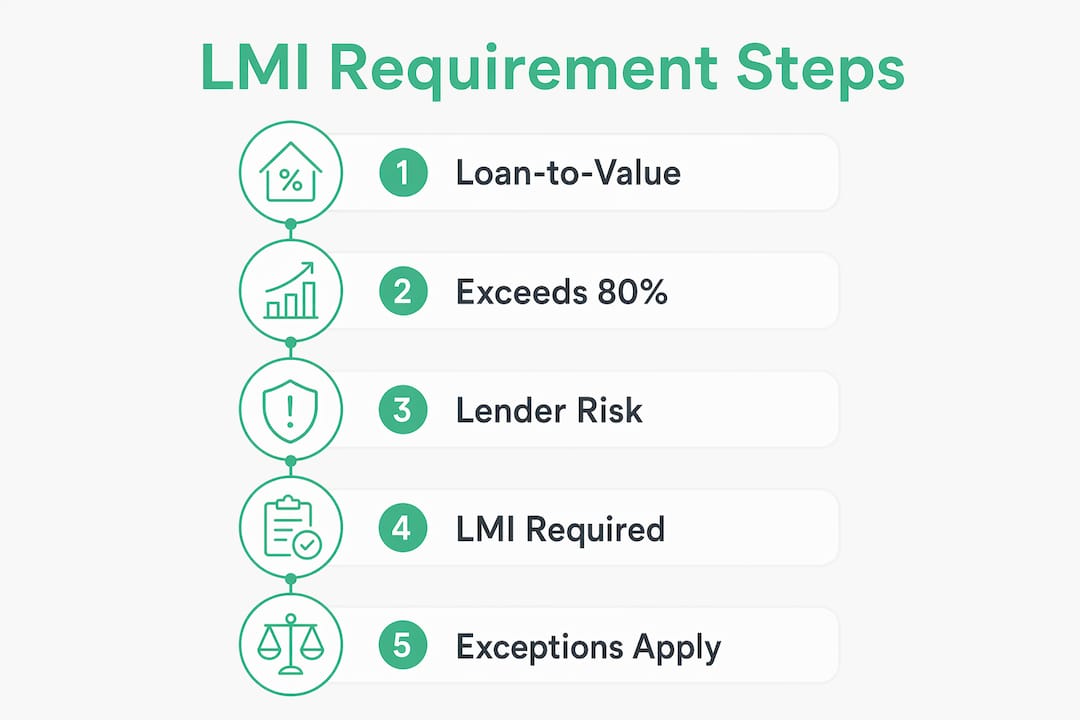
Lenders mortgage insurance (LMI) is an insurance policy taken out by the lender to protect against financial loss if a borrower defaults and the property sale does not cover the outstanding loan balance. LMI applies when your Loan-to-Value Ratio (LVR) exceeds 80%, meaning you have saved less than a 20% deposit. Understanding why lenders require lenders mortgage insurance helps you plan your purchase, weigh your costs, and explore alternatives like the First Home Guarantee. Providers such as Helia and QBE underwrite the majority of LMI policies in Australia, and the premium is paid by you, the borrower, even though the lender is the sole beneficiary.
Why do lenders require lenders mortgage insurance?
Lenders require LMI because a borrower with a small deposit represents a higher risk of financial loss on default. When your LVR sits above 80%, the lender's exposure is significant. If you default and the property sells for less than the loan balance, the lender wears that shortfall without insurance in place.

LMI kicks in at 80% LVR for most lenders, though some set their threshold at 85%. The insurance transfers the lender's risk to a specialist insurer. That transfer is what allows lenders to approve loans they would otherwise decline.
The key triggers for LMI requirements include:
- LVR above 80%: The standard threshold across most Australian lenders.
- LVR above 85%: The threshold used by some lenders with stricter risk policies.
- High-risk borrower profiles: Self-employed applicants or those with irregular income may face LMI at lower LVRs.
- Loan type: Some loan products carry LMI requirements regardless of deposit size.
Professional packages from certain lenders allow borrowing up to 90–95% LVR without LMI, based on your profession and risk profile. Doctors, lawyers, and accountants are common beneficiaries of these arrangements. Government-backed schemes can also remove the LMI requirement entirely for eligible buyers.
Pro Tip: Ask your lender or broker whether your profession qualifies for a waived LMI arrangement before assuming you must pay the premium.
How is LMI paid and what does it cost you?
LMI premiums are paid either as a one-off upfront cost at settlement or capitalised into your loan balance. Capitalising the premium means you borrow the cost of LMI on top of your home loan. That sounds convenient, but it means you pay interest on the LMI premium for the entire life of the loan.
The factors that influence your LMI premium amount are:
- Your LVR: A higher LVR means a larger premium. Borrowing at 95% LVR costs significantly more than borrowing at 82% LVR.
- Your loan amount: Larger loans attract larger premiums, as the lender's potential loss is greater.
- Your borrower risk profile: Lenders and insurers assess income stability, employment type, and credit history.
- Payment method: Capitalising the premium adds interest costs over the loan term.
A useful way to frame the cost decision is to use a financial opportunity calculator to compare the total cost of paying LMI now against the cost of delaying your purchase to save a larger deposit. In rapidly appreciating markets, delaying can cost more than the LMI premium itself, because property prices rise while you save.
Pro Tip: If you can pay the LMI premium upfront rather than capitalising it, you will save a meaningful amount in interest over the life of your loan.
One cost consideration that buyers often miss: LMI premiums are not refundable or transferable. If you refinance your loan before your equity reaches 20%, you will likely pay a new LMI premium on the refinanced loan. Factor that into your long-term planning from the start.
What do borrowers get wrong about LMI?
The most common misconception about LMI is that it protects the borrower. It does not. LMI protects only the lender. You pay the premium, but the lender receives the payout if you default.
"If you default on your loan and the property sells for less than the outstanding balance, the LMI provider pays the lender. The insurer then pursues you for that shortfall. You remain liable for the debt even after the insurance has paid out."
This is the detail that catches borrowers off guard. Many assume that paying LMI means they are covered if things go wrong. The reality is the opposite. LMI removes the lender's risk, not yours.
The second major misconception is that LMI is purely a burden. LMI enables access to loans with deposits as low as 5%, allowing you to buy years earlier than if you waited to save 20%. For a first-time buyer in a rising market, that earlier entry can mean significant equity growth that outweighs the cost of the premium.
Pro Tip: Treat LMI as a market-entry fee, not a protection policy. Understand what it does and does not cover before you sign.
Are there ways to avoid paying LMI?
Several pathways exist to reduce or eliminate LMI costs, and knowing them can save you thousands of dollars.
The First Home Guarantee scheme allows eligible first-time buyers to purchase with a deposit as low as 5% without paying LMI, within property price caps set by the government. The government guarantees the remaining portion of the deposit, removing the lender's risk without requiring LMI. You can find a full breakdown of eligible government schemes for 2026 on the Zenrgfinance blog.
| Option | LMI required? | Deposit needed | Key eligibility condition |
|---|---|---|---|
| Standard home loan (LVR above 80%) | Yes | Less than 20% | No specific criteria |
| First Home Guarantee | No | As low as 5% | First-time buyer, income and price caps apply |
| Professional package | No | As low as 5–10% | Eligible profession (e.g., doctor, lawyer) |
| Guarantor loan | No | Can be zero | Family member provides security |
| Save 20% deposit | No | 20% or more | No specific criteria |
Guarantor loans are another option worth exploring. A family member uses equity in their own property as additional security, which reduces your effective LVR below 80% and removes the LMI requirement. The low deposit scheme has already helped over 150,000 Australian families buy sooner without LMI costs.
Each option carries its own eligibility rules and limitations. Professional packages are not available to all borrowers, and government scheme places are capped each financial year. Shopping around lenders and loan structures is the most reliable way to find an arrangement that suits your situation.
Should you pay LMI or wait to save a bigger deposit?
The right answer depends on your market, your timeline, and your financial position. There is no universal rule, but there is a clear framework for making the decision.
- Compare LMI cost against projected property price growth. If property values in your target area are rising faster than you can save, paying LMI and buying sooner may cost less overall.
- Calculate the total cost of capitalising LMI. Add the interest you will pay on the capitalised premium over your loan term to get the true cost of that choice.
- Factor in equity growth from earlier ownership. Buying two years sooner in a rising market builds equity that can far exceed the LMI premium.
- Plan for refinancing costs. If you refinance before reaching 20% equity, you will pay LMI again. Build that into your decision.
- Check your eligibility for schemes first. Before paying LMI, confirm whether you qualify for the First Home Guarantee or a professional package. Paying LMI when you could avoid it is an unnecessary cost.
LMI removal is based on your original purchase price LVR, not the current market value of your property. You cannot rely on rising property prices to automatically remove LMI from your loan. You need to formally request a valuation and meet the lender's criteria to have it removed.
Key takeaways
Lenders require LMI to protect themselves against financial loss when a borrower's deposit is below 20%, and the borrower pays the premium despite receiving no personal protection from the policy.
| Point | Details |
|---|---|
| LMI protects the lender, not you | You pay the premium, but the lender receives the payout on default. |
| Standard LVR threshold is 80% | Most lenders require LMI when your deposit is less than 20% of the property value. |
| Capitalising LMI increases total cost | Adding the premium to your loan means paying interest on it for the loan's full term. |
| Government schemes can waive LMI | The First Home Guarantee allows eligible buyers to purchase with 5% deposit and no LMI. |
| Refinancing may trigger a new LMI cost | LMI premiums are not transferable; refinancing before 20% equity usually means paying again. |
LMI as a market-entry tool: my honest view
I have spoken with a lot of first-time buyers who walk into a conversation about LMI feeling like they are being penalised for not having a bigger deposit. I understand that reaction. Paying a premium for insurance that does not protect you feels unfair on the surface.
But the framing that actually serves buyers well is this: LMI is the price of admission to the property market when you do not yet have 20% saved. In a market where property values rise year on year, that admission fee can be the best financial decision you make. Waiting two or three years to save a full 20% deposit often costs more in lost equity than the LMI premium ever would have.
The pitfall I see most often is borrowers who capitalise LMI without understanding the long-term interest cost, and then refinance within a few years, triggering a second premium. That double-up is avoidable with proper planning from the start.
My practical advice: before you assume LMI is unavoidable, check your eligibility for the First Home Guarantee and ask your broker whether your profession qualifies for a waived arrangement. If LMI is genuinely your only path forward, run the numbers on buying now versus waiting. In most rising markets, buying sooner wins.
— Allen
How Zenrgfinance can help you navigate LMI
Understanding LMI is one thing. Knowing how it applies to your specific loan, your deposit, and your eligibility for government schemes is another matter entirely.

Zenrgfinance works with first-time buyers and property purchasers across Australia to map out the most cost-effective path to home ownership. That includes assessing whether you qualify for LMI waivers, comparing loan structures, and explaining exactly what your premium will cost over the life of your loan. A mortgage relationship manager from Zenrgfinance can walk you through your options, help you understand the real numbers, and make sure you are not paying LMI when a better option exists. Reach out today and get clarity on your home loan before you commit.
FAQ
What is lenders mortgage insurance?
Lenders mortgage insurance is a policy taken out by the lender to cover financial losses if a borrower defaults and the property sale does not recover the full loan balance. The borrower pays the premium, but the lender is the sole beneficiary.
When is LMI required?
LMI is required when your LVR exceeds 80%, meaning your deposit is less than 20% of the property purchase price. Some lenders set their threshold at 85%.
Does LMI protect the borrower?
LMI does not protect the borrower. If you default, the insurer pays the lender and then pursues you for any remaining shortfall.
Can you avoid paying LMI as a first-time buyer?
Yes. The First Home Guarantee scheme allows eligible first-time buyers to purchase with a 5% deposit and no LMI. Professional packages and guarantor loans are also options that can remove the LMI requirement.
Is LMI refundable if you sell or refinance?
LMI premiums are not refundable or transferable. If you refinance before your equity reaches 20%, you will generally need to pay a new LMI premium on the new loan.