
Renovation finance for investors is a specialised funding approach that covers both the purchase and refurbishment of a property through a single loan, with the loan amount tied to the property's projected value after works are complete. That projected figure is called the after-repair value (ARV), and it sits at the heart of how lenders assess what they will lend you. Unlike a standard home loan, these products are built around your exit strategy, whether that is a sale or a refinance, not just your income and credit history.
A few core concepts are worth knowing before you compare products:
- ARV (after-repair value): the estimated value of the property once renovations are finished, used by lenders to set your maximum loan amount.
- LTV (loan-to-value ratio): the loan expressed as a percentage of the property's current value; ARV-based lending effectively uses a future LTV.
- Draw schedule: renovation funds held in escrow and released in stages as work milestones are verified by an inspector.
- Exit strategy: your plan to repay the loan, either by selling the renovated property or refinancing into a long-term investment loan.
Owner-occupant renovation loans generally carry occupancy requirements and underwriting timelines that do not suit investors. The products built for you, such as hard money loans, fix-and-flip loans, and bridge loans, prioritise speed and asset value over personal income verification. The trade-off is cost: rates are higher and terms are short, typically under 12 months, so loan maturity pressure is a real risk if your renovation runs over schedule.
Pro Tip: Match your loan term to your realistic renovation and sale or refinance timeline, then add a buffer. Projects almost always take longer than planned, and extension fees can erode your margin fast.
Table of Contents
- Common renovation finance options for Australian property investors
- Zenrgfinance can help you find the right renovation finance fit
- Key takeaways
Common renovation finance options for Australian property investors
Australian investors have more choices than many realise. The right fit depends on your strategy, timeline, credit profile, and how much equity you already hold.

Hard money and fix-and-flip loans
Hard money loans are the most widely used tool for active renovation investors. Approval is primarily asset-based, so lenders focus on your ARV estimate and exit plan rather than your personal income. Loan amounts are typically capped at 65%–75% of ARV, with first-time investors usually landing at the lower end of that range. Rates run from 8% to 18%, terms are commonly under 12 months, and funds are released in staged draws after each inspection. Each inspection visit can cost $150 or more, so a project with four or five draws adds a meaningful line item to your budget. Down payments on these loans are generally in the 15%–25% range, depending on lender and project risk.
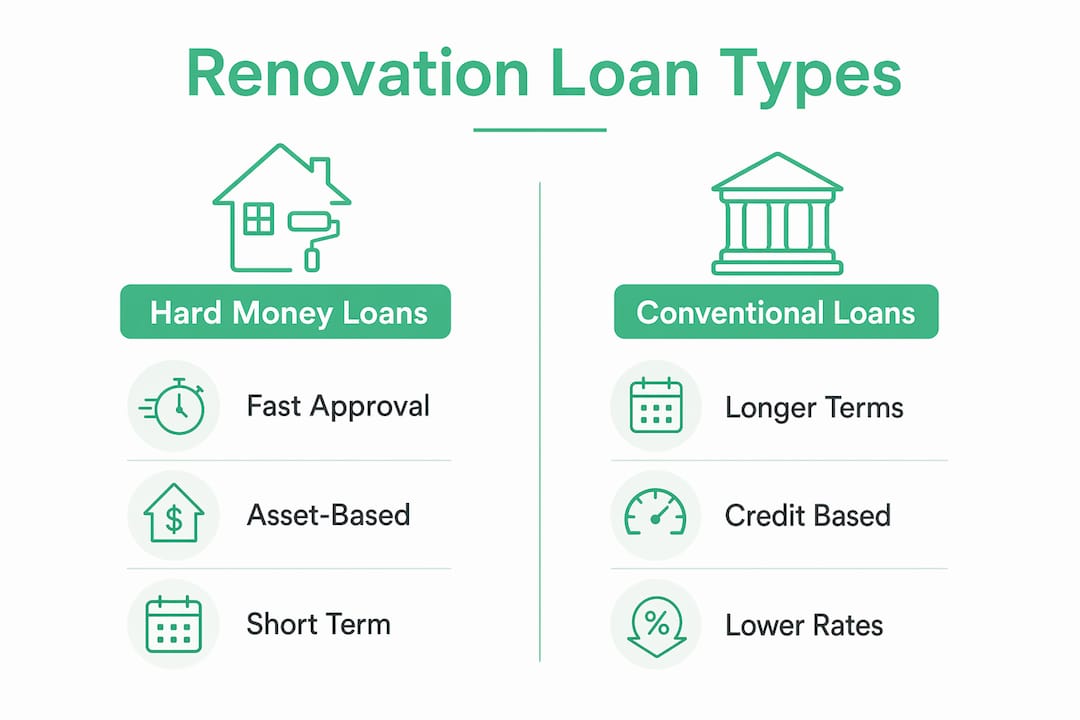
The speed is the appeal. Hard money lenders can settle within days or weeks, which matters in a competitive market. The danger is that if your renovation or sale runs late, extension fees can quickly eat into your profit. Budget conservatively and always model a worst-case timeline.
Bridge loans
Bridge loans share a lot of DNA with hard money products but serve a slightly different purpose. You might use one to acquire a property quickly, complete lighter works, and then refinance into a longer-term investment loan once the property is stabilised. They suit investors who have a clear, short path to permanent financing and need to move fast on a deal.
Conventional renovation loans
Conventional products like Fannie Mae HomeStyle Renovation and Freddie Mac CHOICERenovation are available for one-unit investment properties in the US market, and similar single-close renovation mortgage structures exist in Australia through select lenders. These products finance renovation costs up to 75% of the lower of purchase price plus renovation costs or the completed appraised value. They carry stricter credit and down payment requirements, typically a minimum credit score of 620–640 and a down payment of 15%–25%, but offer lower rates and longer terms than hard money products.
HELOCs and cash-out refinancing
If you already own investment properties with built-up equity, a home equity line of credit (HELOC) or cash-out refinance can fund your next renovation without a separate short-term loan. A HELOC gives you a revolving credit line to draw on as needed. A cash-out refinance replaces your existing mortgage with a larger one and delivers the difference as cash, integrating the renovation funding into your long-term loan structure. Both options carry variable costs and tie repayment to your existing portfolio, so you need solid equity and a clear plan before going down this path. You can explore how home refinancing works as part of this strategy.
The BRRRR strategy
For buy-and-hold investors, the BRRRR approach (Buy, Renovate, Rent, Refinance, Repeat) pairs a short-term hard money or bridge loan for acquisition and renovation with a DSCR (debt service coverage ratio) loan for the refinance. The key is ensuring your ARV and projected rent support both the exit refinance criteria and the long-term debt service. Done well, it lets you recycle capital across multiple deals while building a cash-flowing portfolio. Getting the numbers wrong at the ARV stage is where most BRRRR investors come unstuck, so conservative projections matter.
Pro Tip: Before committing to any renovation loan, get a detailed contractor quote and an independent ARV estimate. Lenders will order their own appraisal, but knowing your numbers first puts you in a much stronger negotiating position.
Here is a quick comparison of the main options:
| Loan type | Typical rate | Term | Down payment | Best suited for |
|---|---|---|---|---|
| Hard money / fix-and-flip | 8%–18% | under 12 months | 15%–25% | Short-term flips, heavy renovation |
| Bridge loan | Higher than conventional | — | Varies | Quick acquisition, light works, fast refinance |
| Conventional renovation loan | Lower than hard money | 15 years | 15%–25% | Longer holds, strong credit profile |
| HELOC | Variable | Draw period varies | Equity in existing property | Portfolio investors with existing equity |
| Cash-out refinance | Variable | Integrated into mortgage | Equity in existing property | Buy-and-hold, BRRRR exit |
Tax implications are worth factoring in too. Renovation costs on an investment property may be deductible or depreciable depending on whether they are classified as repairs or capital improvements under Australian Tax Office guidelines. A quantity surveyor's depreciation schedule can significantly improve your after-tax returns, particularly on a full renovation. Always get advice from a qualified tax professional before you structure your finance.
Approval timelines vary considerably. Hard money loans can settle within days or weeks. Conventional renovation loans involve more detailed underwriting and can take several weeks to a few months. Factor these timelines into your project plan so a delayed settlement does not push your renovation past your loan's maturity date. For a deeper look at how loan type affects your property investment returns, it is worth reviewing your full financing structure before you commit.
Zenrgfinance can help you find the right renovation finance fit
Sorting through renovation finance options on your own takes time, and the wrong choice can cost you more than just money.

Zenrgfinance works with Australian property investors at every stage, from first-time renovators to experienced investors running BRRRR strategies and SMSF portfolios. The team takes a personalised approach to matching you with the right loan structure, whether that is a short-term product for a flip, a cash-out refinance against your existing portfolio, or a more complex SMSF lending arrangement. You get clear guidance on ARV-based lending, draw schedules, and exit strategies, so you go into your project with confidence rather than guesswork.
Ready to get your renovation finance sorted? Talk to the team at Zenrgfinance and get a personalised strategy built around your investment goals.
Key takeaways
Renovation finance for investors works best when your loan term, ARV estimate, and exit strategy are all aligned before you sign anything.
| Point | Details |
|---|---|
| ARV drives your loan amount | Most investor renovation loans are capped at 65%–75% of the after-repair value, not the current property value. |
| Hard money loans carry maturity risk | Terms are typically under 12 months; extension fees apply if renovation or sale runs late. |
| Down payments are higher for investors | Investment property renovation loans generally require 15%–25% down, more than owner-occupant products. |
| BRRRR needs conservative projections | ARV and rent estimates must support both the exit refinance and long-term debt service to recycle capital successfully. |
| Zenrgfinance tailors the strategy | Zenrgfinance matches Australian investors to the right renovation loan structure, from short-term flips to SMSF lending. |