
If you tick the boxes for a government guarantee, that's usually your best starting point because it removes Lenders Mortgage Insurance from the equation entirely. If you don't, a guarantor loan or a standard high-LVR product with LMI attached becomes the fallback.
Here's how the main paths stack up:
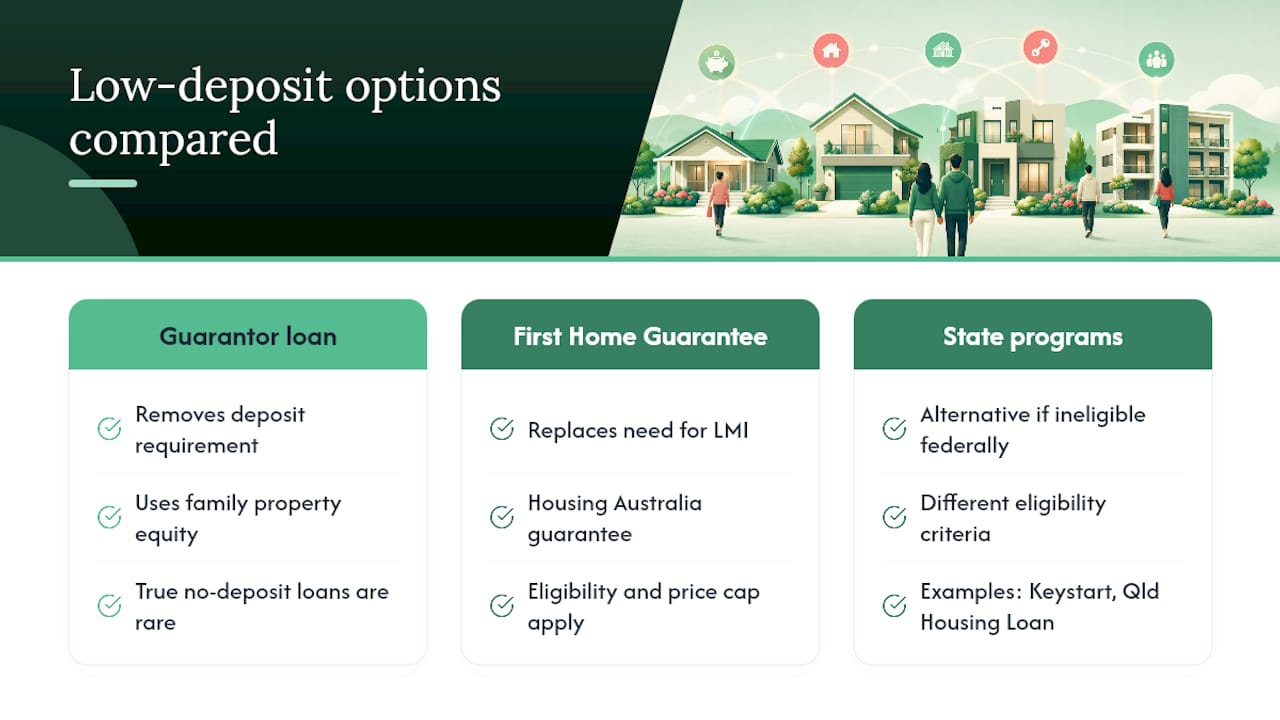
- Federal guarantee schemes – the First Home Guarantee, Family Home Guarantee, and Regional First Home Buyer Guarantee let eligible buyers purchase with a 5% deposit with Housing Australia backing the rest, avoiding LMI.
- State programs – Keystart in Western Australia and the Queensland Housing Finance Loan offer deposits as low as 2% for eligible applicants.
- Guarantor loans – a family member's equity secures part of the loan, sometimes allowing a 0% to 5% deposit.
- Standard low-deposit loans – lenders will approve 90% to 95% LVR loans, but LMI applies.
Pro Tip: Check your eligibility for a government scheme before shopping for lenders. Scheme places are capped annually, and knowing your status first saves weeks of wasted enquiries.
Key Takeaways
| Point | Details |
|---|---|
| Check scheme eligibility first | Federal guarantees avoid LMI entirely for eligible buyers, so confirm income, residency, and price caps before comparing lenders. |
| Genuine savings still matter | Most lenders want 3 to 6 months of saving history, even for scheme-backed or gifted deposits. |
| Know your real loan size | A 5% deposit on a $500,000 home means a $475,000 loan at 95% LVR, not a small commitment. |
| Protect against negative equity | Keep an emergency fund and consider fixing part of your loan when borrowing above 90% LVR. |
| Get broker guidance early | Zenrgfinance checks lender participation in your eligible scheme and structures your application before you start house hunting. |
Table of Contents
- What is a low deposit home loan?
- What are the main low deposit routes available?
- What do lenders check for a low deposit application?
- How much can you borrow with a 5% or 10% deposit?
- What are the real costs and risks of a low deposit loan?
- How do you choose the right low deposit route?
- How do state programs like Keystart and the Queensland Housing Finance Loan compare?
- When does a mortgage broker make the difference?
- Weighing the opportunity against the exposure
- Ready to find your low deposit path?
- Frequently asked questions
- Sources
What is a low deposit home loan?
Canstar's analysis confirms this is the industry-standard cutoff, and it's the point where Lenders Mortgage Insurance typically kicks in.
LVR is simple to calculate: loan amount divided by property value, multiplied by 100.
| Deposit | LVR | LMI typically applies? |
|---|---|---|
| 20% | 80% | No |
| 10% | 90% | Yes (unless scheme-backed) |
| 5% | 95% | Yes (unless scheme-backed) |
- An LMI premium added to your loan (or paid upfront)
- Slightly tighter serviceability checks from the lender
- Possible rate loadings from some lenders at the very top of the LVR range
What are the main low deposit routes available?
Every practical path into the market with a small deposit falls into one of four categories. Knowing which one you qualify for narrows your search fast.
All three come with property price caps that vary by location, and only certain lenders participate, so scheme eligibility alone doesn't guarantee approval.
Roughly a third of first home buyers who've used a guarantee scheme report it was the deciding factor in buying years earlier than they otherwise could have, according to Housing Australia's own scheme documentation. That's a meaningful head start when property prices are climbing faster than most people can save.
State and territory programs. Keystart in Western Australia and the Queensland Housing Finance Loan both offer deposits well below the standard 20%, sometimes as low as 2%, aimed at buyers who might not qualify for mainstream lending.
This route depends entirely on having a guarantor willing and financially able to take on that risk.
- Minimum deposit ranges from 0% (guarantor) to 5% (scheme-backed) to 10% (standard)
- LMI avoidance depends on scheme guarantee or guarantor security, not lender goodwill
- Property price caps and income limits apply to every scheme option, but not to guarantor or standard loans
Pro Tip: Don't assume a scheme place is guaranteed just because you meet the income and residency tests. Housing Australia caps annual places, and popular postcodes can fill their price cap allocation before the financial year ends.
What do lenders check for a low deposit application?
Lenders and guarantee schemes both scrutinise your finances before approving a low-deposit loan, and the checks go well beyond your bank balance.
- Genuine savings – most lenders want to see 3 to 6 months of consistent saving behaviour, not a lump sum that appeared last week. Frasers Property's guide notes this applies even when you're using a government scheme.
- Credit history – missed payments, high credit card limits, or multiple recent enquiries all affect your serviceability assessment.
- Stable income – lenders want at least a few months in your current role, or a solid track record if you're self-employed.
- Existing debts – car loans, personal loans, and buy-now-pay-later balances all reduce your borrowing capacity.
- Scheme-specific criteria – citizenship or permanent residency, not having owned property in Australia before (or in the last decade for some regional guarantees), income caps for some programs, and property price caps tied to your postcode.
Have this ready before you apply:
- Three to six months of bank statements
- Recent payslips or tax returns if self-employed
- Photo ID and proof of address
- Evidence of genuine savings history
Pro Tip: A gifted deposit from family can work, but lenders differ widely on acceptance rules. Get a signed gift letter early and ask your broker which lenders treat gifts as genuine savings.
How much can you borrow with a 5% or 10% deposit?
The maths behind a low deposit loan is straightforward once you see it laid out against real purchase prices.
On a $500,000 property:
- 5% deposit = $25,000, loan of $475,000, 95% LVR
- 10% deposit = $50,000, loan of $450,000, 90% LVR
- 20% deposit = $100,000, loan of $400,000, 80% LVR
On a $700,000 property:
- 5% deposit = $35,000, loan of $665,000, 95% LVR
- 10% deposit = $70,000, loan of $630,000, 90% LVR
- 20% deposit = $140,000, loan of $560,000, 80% LVR
To run your own numbers:
- Multiply the purchase price by your target deposit percentage
- Subtract that figure from the purchase price to get your loan amount
- Divide the loan amount by the purchase price to confirm your LVR
None of this includes stamp duty, conveyancing, or inspection fees, which sit on top of your deposit and can add tens of thousands more depending on your state.
What are the real costs and risks of a low deposit loan?
Buying sooner with a smaller deposit comes at a price, and it's worth understanding both the cost and the risk before you sign anything.

LMI is the most immediate cost. You can usually pay it upfront or capitalise it into your loan, which means paying interest on the premium for the life of the loan.
Higher LVR loans sometimes carry a rate loading, and even without one, a larger loan balance means more interest paid over the loan's life. A smaller deposit also increases your exposure if property values fall, because you have less buffer between what you owe and what the property is worth.
Financial advisers consistently flag negative equity as the sleeper risk of low-deposit borrowing: if the market dips even slightly after settlement, a 95% LVR buyer can owe more than their home is worth almost overnight, while a 20% deposit buyer has room to absorb the same fall.
Practical ways to manage that exposure:
- Keep a dedicated emergency fund separate from your deposit
- Consider fixing part of your loan to lock in repayment certainty
- Where possible, choose a shorter loan term to build equity faster
How do you choose the right low deposit route?
Work through this in order rather than shopping lenders first.
- Check your eligibility against the federal guarantee schemes, including income caps, residency, and property price caps for your target suburb.
- If you don't qualify, check whether your state runs its own program, such as Keystart or the Queensland Housing Finance Loan.
- If neither fits, compare a guarantor loan against a standard high-LVR loan with LMI, weighing the family risk against the insurance cost.
- Speak with a broker who can confirm which lenders participate in your preferred scheme and structure the application correctly the first time.
Before applying, prepare for three stages: pre-approval (income and ID documents), a contract subject to finance (property details and contract of sale), and settlement (final loan documents and insurance).
Ask any lender or broker:
- Does this loan avoid LMI, and under what condition does that change?
- Which lenders on your panel participate in the scheme I qualify for?
- Are there any rate loadings above 90% LVR?
- What fees apply beyond the interest rate?
How do state programs like Keystart and the Queensland Housing Finance Loan compare?
State-run schemes fill gaps the federal guarantees don't always cover, and they're worth checking even if you've already ruled yourself in or out of a national scheme.
The Queensland Housing Finance Loan offers similar low-deposit access with its own repayment structures and eligibility checkpoints, including expanded trials for regional Queensland buyers.
| Program | Typical minimum deposit | Best suited to |
|---|---|---|
| Keystart (WA) | From 2% | WA residents who may not meet standard bank serviceability rules |
| Queensland Housing Finance Loan | Low deposit, varies by product | Queensland buyers, including regional applicants |
Both programs have their own income and eligibility rules that shift periodically, so check the official state housing page for your state before assuming you qualify. Price caps and eligible property types can change from one financial year to the next.
When does a mortgage broker make the difference?
A broker's real value in low-deposit lending is knowing which lenders on their panel actively participate in each guarantee scheme, because not every bank offers every government program. That single piece of knowledge can save weeks of rejected applications.
Beyond scheme access, a broker like Zenrgfinance can run an eligibility pre-check before you apply, structure your application to strengthen your genuine savings position, and negotiate how LMI is calculated or capitalised if you land on a standard low-deposit product. For buyers juggling a guarantor loan against a scheme-backed option, that structuring advice often changes which route makes financial sense.
- Confirms lender participation in your eligible scheme before you apply
- Pre-checks eligibility to avoid wasted applications
- Structures your loan to minimise LMI exposure where a scheme isn't available
Pro Tip: Book a strategy session before you start house hunting, not after you've found a property. Scheme eligibility and lender participation can change your budget by tens of thousands of dollars.
Weighing the opportunity against the exposure
When a scheme genuinely fits your situation, income, and target suburb, I think it's one of the more sensible ways to stop paying rent while prices climb.
The buyers who do well with a small deposit are the ones who pair it with an emergency fund, consider fixing part of the loan for certainty, and budget conservatively for renovations rather than assuming equity will cover it. Buy for stability first, not for speed.
Ready to find your low deposit path?
Working out which scheme, state program, or lender product actually fits your situation takes more than a quick calculator, and getting it wrong can cost you thousands in avoidable LMI or a missed scheme place. Zenrgfinance works across a broad lender panel, which means we can confirm exactly which banks participate in your eligible guarantee scheme rather than you calling around one by one.

Our brokers run eligibility pre-checks against the current federal and state programs, structure your application to protect your genuine savings position, and handle LMI negotiation if a scheme isn't available to you. If you're ready to see which route fits your deposit and your goals, book a session with our mortgage relationship manager and get a clear answer on your options before you start making offers.
Frequently asked questions
What is considered a low deposit home loan?
Can I buy a home with no deposit at all? True no-deposit loans are rare now, but a guarantor loan can effectively remove the deposit requirement by using a family member's property equity as additional security instead.
Do I have to pay LMI if I use a government guarantee scheme? No. Under the First Home Guarantee and related schemes, Housing Australia's guarantee replaces the need for LMI, provided you meet the eligibility and price cap conditions.
How is the Family Home Guarantee different from the First Home Guarantee?
Should I choose a state program or a federal scheme? Check federal eligibility first, since guarantees like the First Home Guarantee are widely available. If you don't qualify, state programs such as Keystart or the Queensland Housing Finance Loan may offer a viable alternative with different criteria.
This article is general information, not a substitute for advice from a qualified financial advisor. Consult a qualified financial professional about your own circumstances before acting on anything here.