
The best alternatives to brokerpages.com.au are independent broker directories like AllBrokers, BrokerList, and LookUp Brokers; verified comparison sites like Finder and Canstar; or going direct to a specialist brokerage like Zenrgfinance. Each route suits a different borrower, and knowing which fits your situation saves a lot of back-and-forth.
Here's what makes these options worth your time:
- Independent directories let you search by suburb or postcode, filter by loan type (investment, SMSF, first home), and view a broker's credentials before you hand over your details.
- Verified comparison sites surface lender-panel disclosures and aggregated ratings, useful for a quick shortlist when you're not sure where to start.
- Direct specialist brokerages like Zenrgfinance skip the directory step entirely and give you a dedicated adviser who maps your situation to the right lenders from day one.
Your immediate next step: search by your suburb, check the broker's ACL on ASIC Connect, then book no-obligation chats with two or three brokers before committing.
Pro Tip: Never share your contact details with a platform before you've confirmed the broker holds a valid Australian Credit Licence (ACL) or is listed as a credit representative on ASIC Connect.
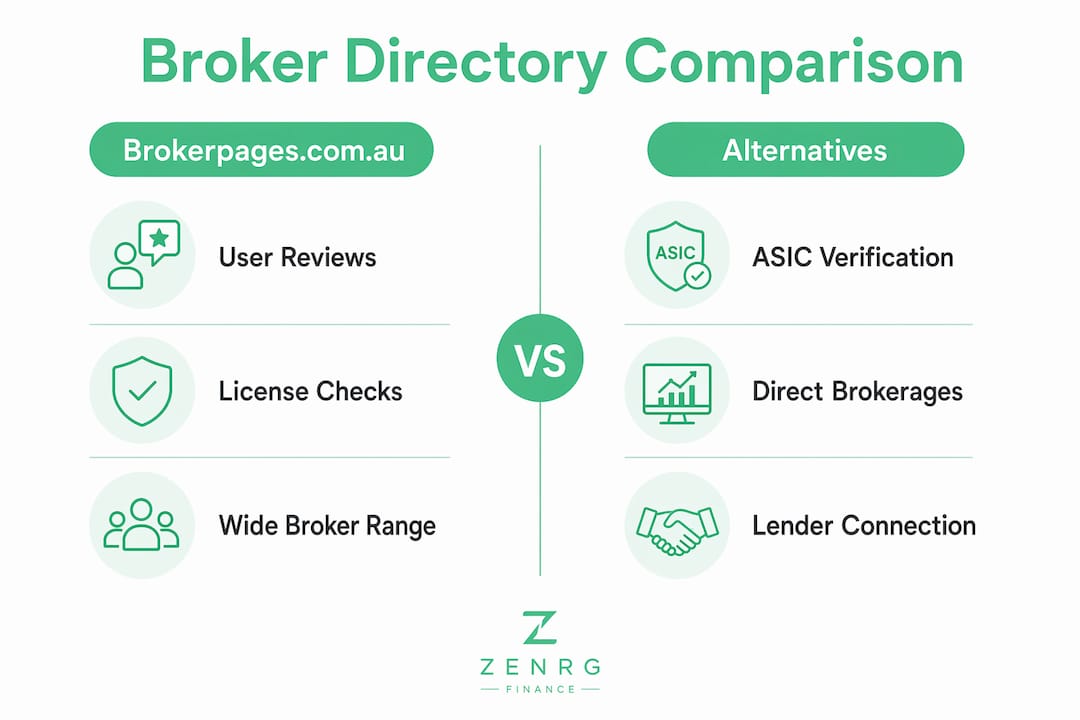
Table of Contents
- How do the main brokerpages.com.au alternatives compare?
- How do you pick the right platform and broker?
- What happens after you click contact on a broker directory?
- Which alternatives offer the broadest range of brokers?
- How do service quality and support differ across alternatives?
- How well do these platforms connect with lenders and loan applications?
- How do review and ratings systems work on each platform?
- Zenrgfinance: a personalised alternative to broker directories
- Key takeaways
- What actually matters when you're choosing a broker
- Where to verify brokers and find authoritative information
How do the main brokerpages.com.au alternatives compare?
| Category | Best for | How you connect | Lender panel & fee transparency | Verification & credentials | Filters & search | Privacy / lead handling |
|---|---|---|---|---|---|---|
| Independent directory (AllBrokers, LookUp Brokers) | Investors, SMSF, first-home buyers | Direct contact after browsing | Lender access listed; fee disclosure varies by broker | ACL numbers surfaced; MFAA/FBAA membership shown | Postcode, loan type, language, specialisation | Profile-first; contact optional |
| Verified comparison site (Finder, Canstar) | First-home buyers, refinancers | Lead form or click-through | Aggregated ratings; limited lender-panel depth | Licence checks vary by platform | Loan type, rate type | Lead may be shared with multiple brokers |
| Direct specialist brokerage (Zenrgfinance) | First-home, investor, SMSF, development | Direct adviser relationship | Full lender-panel disclosure; fee structure explained upfront | ACL-licensed; MFAA/FBAA membership | N/A — adviser matches you | Your details stay with one firm |
A few things worth calling out:
- Independent directories give you the most control. You browse, compare, and reach out on your own terms. AllBrokers, for instance, lists access to 150+ lenders including major banks, regional lenders, and non-bank lenders.
- Verified comparison sites are a fast starting point but can funnel your details to several brokers at once, which means multiple follow-up calls you may not have expected.
- Direct brokerages remove the search step entirely. The trade-off is that you're trusting one firm's lender panel, so checking that panel depth upfront matters.
Pro Tip: If a platform asks for your name, phone number, and email before it shows you a single broker's licence number or lender panel, treat that as a lead-sell model, not an independent discovery tool.
How do you pick the right platform and broker?
Work through this checklist before shortlisting anyone:
- Confirm ACL or credit representative status on ASIC Connect — a platform badge is not enough.
- Check MFAA or FBAA membership, which signals ongoing professional development and a complaints pathway.
- Ask for the lender panel in writing — how many lenders, which categories (major bank, non-bank, specialist)?
- Clarify fee structure — most brokers are paid by lenders via trail commissions, but some charge direct fees. MoneySmart advises borrowers to ask for a clear disclosure of how their broker is paid.
- Verify client reviews — check whether the platform independently verifies reviews or simply publishes self-reported ratings.
- Match specialist experience to your need — SMSF lending, development finance, and investor strategies each require specific lender relationships and product knowledge.
Questions to ask a shortlisted broker directly:
- Which lenders on your panel offer products for my situation (first home / investment / SMSF)?
- What's a realistic timeline from application to conditional approval for my loan type?
- How are you remunerated, and are there any lenders you're incentivised to recommend?
- What happens if my application is declined — do you have alternative lenders to approach?
Shortlisting by a broker's specialist experience — particularly for SMSF lending or development finance — usually leads to better outcomes than relying on public star ratings alone. A broker with a four-star average and deep non-bank lender access will often outperform a five-star generalist for a complex investor case.
Pro Tip: For investor or SMSF borrowers, lender-panel breadth matters more than popularity. Access to regional and non-bank lenders can be the difference between approval and a dead end.
What happens after you click contact on a broker directory?
The typical journey looks like this:
- Search by postcode or suburb, then filter by loan type and specialisation.
- View credentials — a good platform surfaces ACL numbers, MFAA/FBAA membership, and lender-panel summaries before you make contact.
- Send an enquiry or call directly for a no-obligation appointment.
- Initial consultation — usually 30–60 minutes, free of charge, covering your goals, borrowing capacity, and loan structure options.
Timeline-wise, getting from enquiry to conditional approval varies by lender and complexity, but a straightforward owner-occupier loan can move from first meeting to conditional approval in two to four weeks. SMSF and development loans typically take longer given the additional documentation.
Cost to use a directory: free. Most brokers earn trail commissions from lenders rather than charging borrowers directly. If a broker quotes an upfront client fee, ask for a written explanation before proceeding.
The key distinction to watch for: discovery platforms let you view full profiles before sharing your details; lead-referral models collect your contact information first and distribute it to multiple brokers. Knowing which type you're on shapes what to expect in your inbox.
Pro Tip: Treat directories as research tools. Gather ACL numbers, compare two or three brokers, and only then share your contact details with the one whose panel and experience best match your loan type.
Which alternatives offer the broadest range of brokers?
AllBrokers and LookUp Brokers both position themselves as large-scale directories covering metropolitan and regional Australia. LookUp Brokers offers extensive search filters including loan type, language, and location, which is particularly useful if you want a broker who speaks your preferred language or has experience in a specific state market.

BrokerList takes a narrower but more curated approach, verifying brokers against ASIC records and checking professional indemnity before listing. Fewer listings, but each one has passed a documented check.
Finder and Canstar draw from a broader financial-products universe, so their mortgage-broker sections sit alongside rate comparison tools. Useful for context, though the broker profiles tend to be less detailed than a dedicated directory.
One platform worth knowing about if you're searching broadly: Compare Mortgage Brokers (comparemortgagebrokers.com.au) advertises Australia's largest broker database with language and lender-access filters. Worth a look if the other directories don't surface a specialist in your area.
How do service quality and support differ across alternatives?
Directories are self-service by design. You do the filtering, you make the call, and the quality of your experience depends almost entirely on the individual broker you choose. The platform itself typically offers no ongoing support once you've made contact.
Verified comparison sites like Finder and Canstar add editorial content and rate comparisons alongside broker listings, which can help you frame the right questions before your first appointment. Their customer support tends to be geared toward the platform itself rather than your loan journey.
Direct brokerages sit at the other end of the spectrum. With Zenrgfinance, for example, you're assigned a dedicated adviser who stays with you from initial discovery through to settlement, and beyond for refinancing reviews. That continuity matters when your situation changes mid-application or when a lender requests additional documentation at short notice.
The practical difference: a directory helps you find someone; a direct brokerage is that someone.
How well do these platforms connect with lenders and loan applications?
Directories don't connect to lenders directly. They're connectors to brokers, who then manage the lender relationship and application process on your behalf. The integration with actual loan applications happens at the broker level, not the platform level.
Finder and Canstar go a step further by embedding rate-comparison tools that pull live or near-live product data from lenders, giving you a sense of where rates sit before you speak to a broker. That context is genuinely useful, though the displayed rates are indicative and your actual rate depends on your financial profile.
Zenrgfinance, as a direct brokerage, manages the full application workflow including document collection, lender submission, and follow-up. If you're buying your first home, coordinating your broker and conveyancer early is worth doing — understanding the conveyancer's role in a property purchase helps you avoid timing gaps between finance approval and settlement.
How do review and ratings systems work on each platform?
This is where platforms vary most, and where borrowers are most likely to be misled. Self-reported ratings with no verification process are common on smaller directories. A broker with 50 five-star reviews that were never independently checked tells you very little.
BrokerList's ASIC-verification step applies to credentials, not reviews, but the credential check itself is a meaningful trust signal. AllBrokers surfaces ratings alongside specialisation details, though the verification methodology for individual reviews is not publicly detailed.
Finder and Canstar use editorial scoring methodologies alongside user reviews, which adds a layer of consistency. Their scoring criteria are generally published, so you can see what's being measured.
The safest approach: treat star ratings as a starting point, not a verdict. Cross-reference with the broker's ACL status on ASIC Connect, ask for referees if your loan is complex, and use directories as research tools rather than as endorsements.
Zenrgfinance: a personalised alternative to broker directories
Searching directories is useful. But for first-home buyers navigating the Home Guarantee Scheme, investors structuring a portfolio loan, or borrowers considering SMSF lending, the directory step can add weeks of back-and-forth with generalist brokers who don't specialise in your situation.

Zenrgfinance works differently. You get a dedicated mortgage relationship manager who maps your goals to a specific lender strategy, not a shortlist of names to call yourself. The process starts with a discovery conversation, moves to lender-panel mapping based on your actual borrowing profile, and continues through application, approval, and settlement. For property investors, the property investment finance service covers portfolio structuring, equity release, and investor-specific lender access.
Credentials, fee structure, and lender-panel details are disclosed upfront. No lead-selling, no multiple brokers calling you the same afternoon.
Ready to skip the directory search? Book a conversation with a mortgage relationship manager and get a lender strategy built around your situation from the first call.
Key takeaways
The most reliable path to a good broker outcome in Australia is to verify credentials on ASIC Connect, match the broker's lender panel to your loan type, and choose a platform that shows you credentials before asking for your contact details.
| Point | Details |
|---|---|
| Verify ACL on ASIC Connect | Always confirm a broker's licence number on ASIC Connect before sharing personal details. |
| Panel depth beats star ratings | For investor or SMSF loans, a broker's lender-panel breadth matters more than their public rating. |
| Directories are connectors, not advisers | MoneySmart confirms that broker directories aggregate options but do not replace licensed credit advice. |
| Watch for lead-sell models | Platforms that require your contact details before showing credentials are often distributing your leads to multiple brokers. |
| Zenrgfinance as a direct route | Zenrgfinance offers a dedicated adviser, full lender-panel disclosure, and end-to-end application support as an alternative to directory searching. |
What actually matters when you're choosing a broker
The most common mistake I see borrowers make is treating a high star rating as a proxy for lender-panel fit. A broker with strong reviews and a panel of six lenders is the wrong choice for an SMSF borrower who needs access to specialist non-bank products. The rating reflects client satisfaction, not product range.
Lender-panel depth, realistic timelines, and clear fee disclosure are the three things worth asking about in your first conversation. A broker who can tell you exactly which lenders on their panel have approved loans like yours in the past six months is giving you something a directory profile never can. On paperwork: get your tax returns, payslips, and bank statements ready before your first appointment. Brokers who receive complete documentation at the first meeting consistently report faster conditional approvals. That's not a coincidence.
Where to verify brokers and find authoritative information
Before you shortlist anyone, run their details through these resources:
- ASIC Connect Professional Registers — the authoritative source for confirming ACL numbers and credit representative status. Use this before sharing any personal information.
- MoneySmart — Australian Government financial guidance covering broker fees, commission structures, and how to evaluate a broker's advice.
- MFAA (Mortgage & Finance Association of Australia) — membership search confirms professional standing and access to a formal complaints process.
- FBAA (Finance Brokers Association of Australia) — an alternative membership body; check both if a broker's profile doesn't specify which they belong to.
When reviewing a directory listing, check three things: whether the platform verifies ACL numbers independently, how client reviews are collected and validated, and whether the privacy policy explains how your contact details are handled after you submit an enquiry.
Primary alternatives for further browsing:
- AllBrokers
- BrokerList
- LookUp Brokers
- Compare Mortgage Brokers
This article is general information only and does not constitute financial or credit advice. Verify current licensing requirements and confirm your own circumstances with a licensed credit adviser or ASIC's professional registers before making any borrowing decisions.